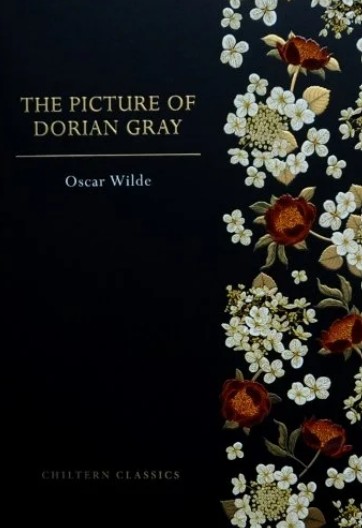
The Picture of Dorian Gray by Oscar Wilde
Description:
“When having his portrait painted, Dorian Gray declares he would give anything to stay youthful – even his soul. Dorian descends into a life of decadent excess, and while he retains his youthful looks, the portrait becomes horrifically disfigured. Oscar Wilde’s only novel is a dark, Faustian fable of wish fulfilment that leads to an inescapable day of reckoning.
The Chiltern Publishing paperback range combines elegant design with high-quality craftsmanship.
Each edition is finished with coloured endpapers and generous 90 mm flaps, printed on luxurious 100 gsm cream paper and features sewn paperback binding, ensuring durability while allowing the pages to open comfortably and maintain the strength expected of a premium edition.
Thoughtfully produced and designed to last, the Chiltern Publishing paperback range offers readers a refined reading experience while preserving the timeless aesthetic that defines Chiltern Publishing.”
My review:
I am giving this book a rating of 3 out of 5.
Before I begin my review, I think it’s worth noting that this book was originally written and published in the Victorian era (though I read a Chiltern Classics copy produced in 2025 that I bought in Hay-on-Wye in 2026). For this reason, the narrative style, perspective, and social experiences of the time should be considered – since (many aspects of) the world today would be unrecognisable in comparison!
The prose is as self-indulgent as Dorian Gray himself, which I’m assuming is by design. For instance, Chapter 11 contained heavy exposition spanning around two decades of the story’s timeline. I did find the ending successfully satisfied the novel’s overall theme as to the costs of selfishness and pursuit of vanity, though.
In terms of character: Lord Henry is clearly a horrible person (as well as a dangerous influence and extremely unlikeable!), Basil the painter definitely would’ve benefitted from getting out more, and Dorian Gray is the epitome of vanity without intellect. Repetitive dialogue tags stating that characters ‘cried this’ or ‘cried that’ quickly became irritating. There was a lot of monologuing as well, which I guess is to be expected in a novel of this era, though it did get tiring at times.
I took a while to finish reading this book, despite the fact it’s only around 55k words in length, because the conceited writing style wasn’t my cup of tea (neither were the instances of racism and sexism, which were extremely hard to read; I put the book down many times and almost didn’t pick it back up again…). However, I realise that these perspectives are from a totally different era, and that the very purpose of this novel is to force readers to consider the cost of putting their pursuit of outward beauty and hedonism in a place of importance over all other aspects of life – and that doing so causes significant harm to both the narcissist and those around him. Given that the conventionally narrow view of human beauty is ever-changing (based on whichever trends keep people feeling less than enough and willing to pay whatever it takes to fit beauty standards according the culture and particular era they find themselves in), the almost airheaded gullibility of Dorian Gray showcases how foolish it is to pursue something that is shallow over trying to live a good life by caring about others.
The message of being careful not to get dragged into a world of comparison and perfectionism is powerful, especially in today’s world of ever-changing beauty standards that are increasingly more difficult to attain (especially for normal people in real life, for whom it’s impossible to walk around looking the same as they do in heavily edited photographs, yet who feel badly about themselves for looking like an actual human being with natural ‘imperfections’).
Among a few of the quotes I found fascinating was the following on p.160: “His great wealth was a certain element of security. Society – civilized society, at least – is never ready to believe anything to the detriment of those who are both rich and fascinating. It feels instinctively that manners are of more importance than morals, and, in its opinion, the highest respectability is of much less value than the possession of a good chef. And, after all, it is a very poor consolation to be told that the man who has given one a bad dinner, or poor wine, is irreproachable in his private life. Even the cardinal virtues cannot atone for half-cold entrées […]” – If they recognised this fault of society over 130 years ago, that someone’s wealth automatically pays for the acceptance of their indiscretions and vile behaviour, then why hasn’t anything changed? The uber-wealthy, many of whom are needlessly destroying our planet and making life harder for the rest of us through shortsighted, money-driven actions are still not held accountable for the terrible things they’re doing (we’re looking at you AI companies, which could be curing diseases and advancing scientific studies but aren’t, because there’s more immediate monetary gains to be had by already-wealthy company leaders through ripping off artists and stealing their livelihoods from them instead).
At what point did humanity decide to give power to these selfish people, who just happened to be born into a financially beneficial position in life, instead of actually making the world a better place for everyone by ensuring that society’s leaders and influencers are genuine, kind, respectful human beings? Apologies for the rant, though I have to say this book does a brilliant job of highlighting these issues of society, some of which are still relevant today, even if it doesn’t necessarily offer an answer as to how we – as ordinary people – can do anything to change it. In saying this, I found the way women were portrayed throughout this novel to be extremely disrespectful – I know that’s because of the time this novel was written, and likely because the author did not find women as attractive or inspirational as men, though it’s something that impacted my enjoyment of the novel as a female reader in my thirties and made it tough to edge the rating any higher…
Ultimately, if you’re hoping for a palette cleanser of a story, this isn’t it! I’d only recommend reading if you’re interested in exploring a fresh perspective of the Victorian era not generally explored in other novels of the time, or if you’re educating yourself on classic literature (as I am) and hope to learn something from expanding your reading list.
Side note: I think you should avoid this book if you dislike adverbs and entire chapters of exposition 🙂
Read in: August 2026
Format: Paperback
I’m including the date and format in which I experienced this story for transparency, since whatever is going on in the world (and a reader’s private life) at the time of reading, along with a book’s reading format, can influence an individual’s enjoyment of a story.
Disclaimer: I purchased this book (during a visit to wonderful Hay-on-Wye!). All opinions expressed in this review are mine and have not been influenced by the author or publisher in any way. This book review does not contain affiliate links.